
The pattern
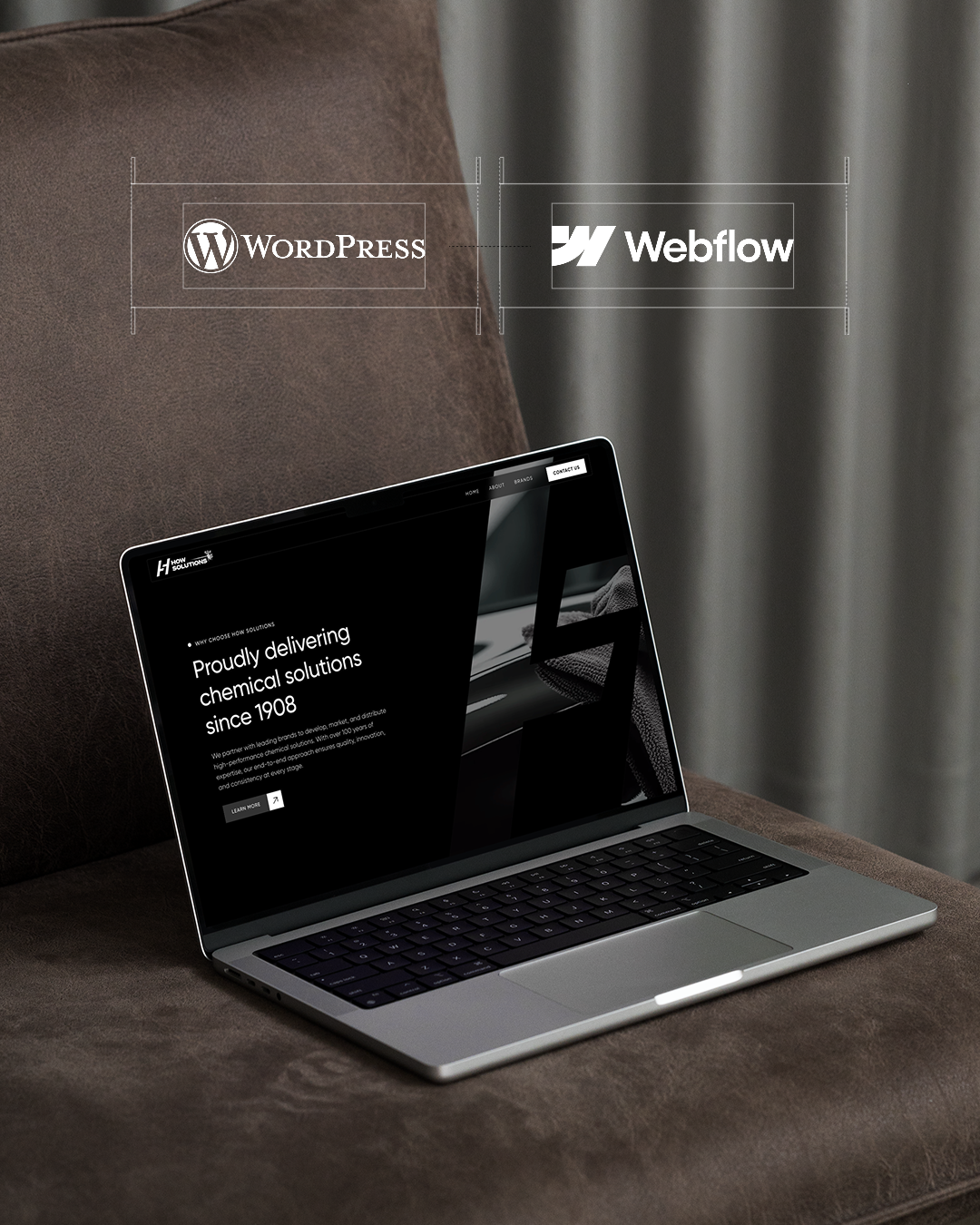
The decision to move from WordPress to Webflow rarely comes suddenly. It builds. A business reaches a point where the maintenance overhead has become an ongoing cost that delivers no commercial value, where the design quality has plateaued because the theme has limits, or where the team cannot make changes without going back to a developer for everything. Usually all three at once.
The maintenance problem
A WordPress site running a typical plugin stack requires regular attention: core updates, theme updates, plugin updates and the occasional compatibility conflict when one update breaks something another plugin depended on. Security vulnerabilities in outdated plugins are a recurring concern. For a business without an in-house developer, this means either paying a developer to manage it or letting updates slide. Neither outcome is good.
Webflow handles its own infrastructure. There is no plugin stack to maintain, no security patches to apply and no version conflicts to resolve. The business pays a monthly hosting fee and does not need to think about the underlying platform. For most businesses, that is the better arrangement.
The design ceiling
WordPress themes define the visual language of a site. Customising beyond the theme's design intent is possible but requires developer time, and the result is often fragile. A business that wants a genuinely distinctive site usually reaches the limits of what its WordPress theme supports within two or three years of launch.
In Webflow, the design starts from a blank canvas. There is no theme constraining the layout, the typography or the interaction design. A Webflow site can be built exactly as designed.
The team dependency problem
A WordPress site can be built so that non-technical users manage content. In practice, many are not. Plugin interfaces vary, the editor has quirks and changes outside the editorial content often require developer access. A business whose team cannot make routine updates without going back to an agency is permanently dependent on that agency.
Webflow's Editor is built specifically for non-technical content management. A properly trained client team can update pages, add CMS entries and manage most content without developer involvement. The handover is a defined part of the project.
What the migration involves
The design is rebuilt in Webflow, either as a faithful lift of the existing site or as a redesign at the same time. Content is migrated into the Webflow CMS. All old URLs that were ranking in search need 301 redirects to their new equivalents so search traffic is preserved. The migration is a project, not a switch, and is worth doing properly.
Frequently asked questions
Will I lose my search rankings when I migrate?
Not if the migration is handled correctly. The critical step is setting up 301 redirects from every old URL to its new equivalent before the old site is taken down. A migration that skips this step effectively starts from zero in search. Done properly, most rankings are preserved and often improve as the faster Webflow site benefits from better Core Web Vitals scores.
How long does a WordPress to Webflow migration take?
A migration of a ten to twenty page site, done properly with a design review and full redirect management, typically runs eight to fourteen weeks. A larger site or one combined with a significant redesign runs longer.
Do I need to redesign when I migrate?
Not necessarily. Some businesses migrate their existing design into Webflow faithfully, benefiting from the platform advantages without changing the visual. Others use the migration as an opportunity to redesign. Both are valid choices at different price points.
Is Webflow worth the cost of migrating from WordPress?
The calculation usually looks like this: compare the ongoing cost of WordPress maintenance, including developer time and occasional emergency fixes, against the Webflow hosting fee and a lower ongoing support requirement. For most businesses, the migration pays for itself within two to three years and continues to save money after that.